Activates cooking mode with step tracking, timers, and screen wake lock
Usually it all ends with me focused on the bread the whole day, taking up too much space in the kitchen, leaving a lot of mess that she needs to look at before I clean it up. But this time it wasn’t that bad. I hope.
I decided to look into Jeffrey Hamelman’s “Bread” and use a recipe with seeds. I have some malted cracked rye seeds that are about to expire in December, so using them was one of my goals. The bread I chose accepts any type of seeds, and I made it once before, with sunflower, linseed and millet. It’s been a while, so I was curious what the outcome would be.
In the evening I prepared the levain and soaked the seeds, then in the morning mixed all the ingredients, let it rise, folded, formed, waited, and baked. The recipe calls for yeast in the final dough. It certainly speeds up the process, but doesn’t seem essential. I haven’t tried without it.
Ingredients
Levain
110 g strong wheat flour
140 g water
20 g sourdough
Soaked seeds
160 g seeds (in my case cracked malted rye)
200 g water (if the seeds are hard, such as rye, buckwheat, millet, use boiling water)
The final dough
360 g seeds
270 g levain (the author said to leave out 1.5 tbsp, for the new levain, I’m guessing – I didn’t)
340 g strong wheat flour
450 g whole wheat flour
350 g water
20 g salt
5 g instant yeast (12-13 g fresh)
30 g honey (I used buckwheat honey that we got from my in-laws)
The above quantities were enough to create three moderate size loaves.
Instructions
In the evening, mix levain ingredients and put aside covered for the night (12-16 hours)
In the evening, pour water onto the seeds (boiling, if the seeds are hard), cover with cling film an put aside for the night
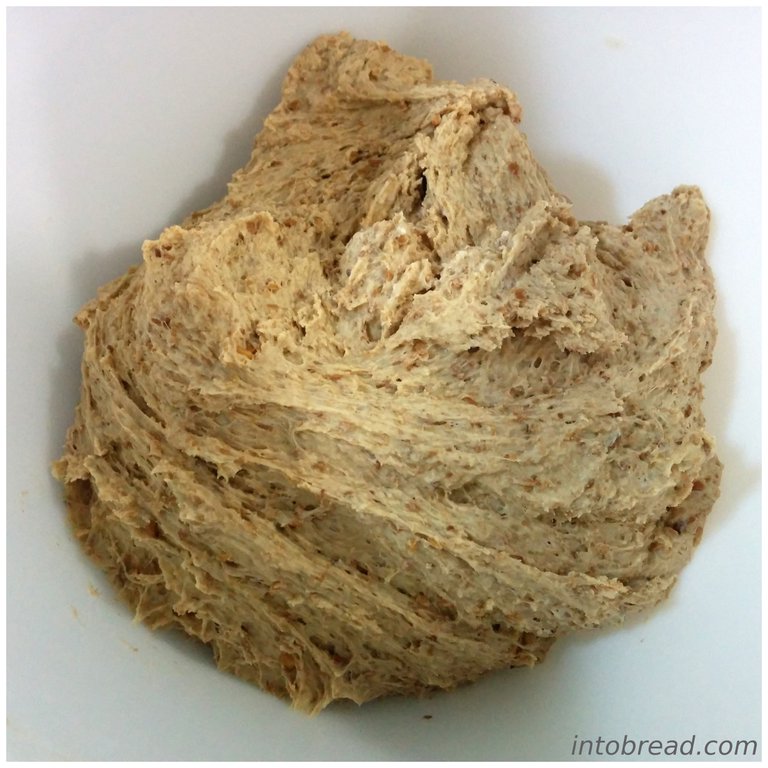
In the morning, mix all ingredients together to form a springy dough. It took me about 5-6 minutes in my mixer with a dough hook. You could clearly tell the moment it was ready, as in an instant the dough detached fully from the bowl walls and started spinning on the hook. Notice that the dough is quite brown. This is because the malted seeds released red-brown colour into the water. Also using buckwheat honey helped as it has an intense, dark brown colour
Kneaded dough
Leave the dough to proof for 1-2 hours (until it doubles in size, I’m guessing, the author does not explain why 1 hour flexibility). If you do 2 hours, fold the dough after 1 hour
Divide the dough into portions. You can make two and use bannetons, but I wanted to practice batards shaping, so I made three slightly smaller loaves. If you have no bannetons, you can use a bowl and a clean floured tea towel. Use preferably rye or rice flour, as they will not stick as easily as wheat flour
Leave it for one more hour to rise. After about 30 minutes turn your oven on. The author says it should be 240 C with steam. I used around 200 C up and down. As usual, you know your oven
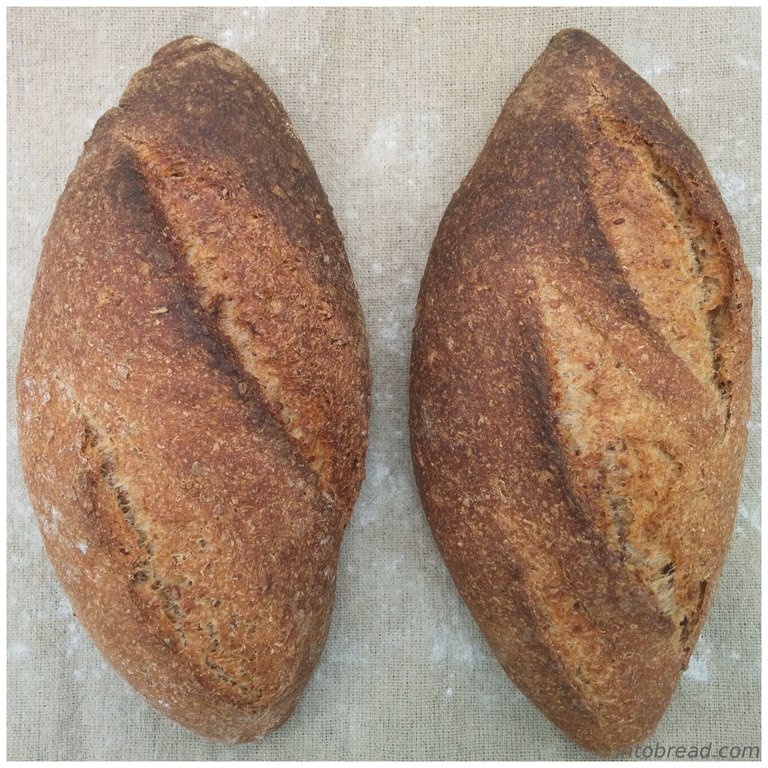
Pop the loaves into the oven for 40-50 minutes. I recommend you score them with a sharp knife for a controlled crack in the crust
pszenny_ready
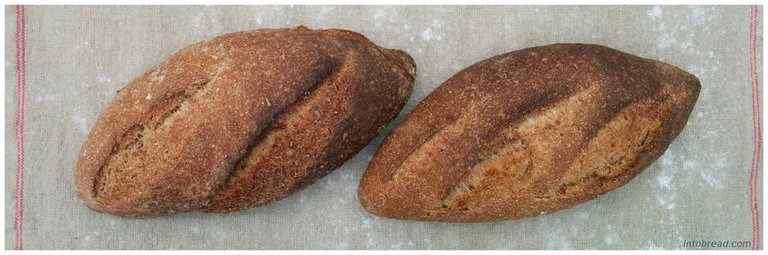
It was working out perfectly. Every single stage. And by the very end I forgot about them slightly and let them burn a little. It wasn’t much of an issue, but the fact that the crust got super crusty and was scratchy, actually was an issue. It stabilised the following day.
The taste was really nice. You could feel the sweetness from honey and malt, but it wasn’t overwhelming. Worked well with cooked meat.